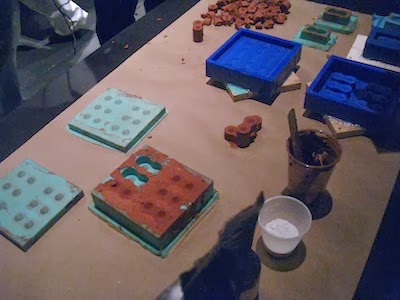
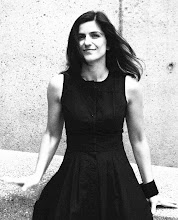
Women in Design (WID) have been organizing a series of very relevant and eye-opening informal lunch/breakfast meetings, each time featuring a distinguished female professional of the architectural realm. In this text, I am recapping my notes from the April 2nd WID lunch with Caroline Jones, Professor of Art History at MIT, at Byerly Hall Room 231 in the Radcliffe Yard.
"She [Cynthia Davidson] also cited her interview from Log 30 Winter 2014 with Elia Zenghelis, who said, 'I believe, generally speaking, that women are better at architecture than men, even though in my 45 years of teaching, of my four best students, three were men. I believe this is the case only because the men paid greater attention to the fundamental importance of the frame and context of architecture in human culture and history, and therefore to the importance of theory. This is a responsibility that talented women still have to undertake.' Davidson didn’t pass judgment on Zenghelis’ statement, but she seemed to be pointing out a belief held by an authority in architecture."
Jones, who found the Zenghelis' quote "shocking," embraced James' invitation to discuss what is considered as Theory. In relation to theory within the art/architectural realm, Jones referred to her experience teaching in Boston University (BU) before coming to MIT in 2001. At that time, even a word like "method" sounded very theoretical (and scary). But even nowadays, for her current teaching approach, Jones favored teaching dominant threads (instead of canons) on visual domains.
Other participants brought up the dipoles: social practice (grounded and practical) versus theory, or contemporary theory versus conceptual art (conceptual artists that are not necessary theorists). In relation to art/architecture, Jones shared how her courses are elective, and therefore peripheral to Master of Architecture students at MIT. She
mentioned the difficulty of being an Art historian within an
Architectural Department: Architects know about art, but artists do not
know a lot about architecture. Jones discussed the difference between architects who recognize the need for the discourse (even if it is not them who write) in relationship to artists that do not want to say much (in order to keep things ambiguous, to maintain a space of projection, and for viewer's interpretation). To resolve some of the aforementioned issues in her class, she asks from the students to pretend to be this other person who writes about the work (for example the curator, the producer who puts the show, etc).
Jones discussed as well her current research (and book) on art and globalism as a Radcliffe fellow: How art functions in world’s fairs, national pavilions, and biennial culture; how art operates differently when it is in the context of a global assemblage; and how the artist becomes subject to these global discourses. In the meeting, she explained that the discussion of the 80s on durational works of art are still relevant: Biennal is not just a spectacle, it is a provocative space where different economies of experience take place. A biennal can spread the ambitions of an architect. Within this context, architecture can become a way to debate about things. It can become political.
On the practice versus theory dipole, James mentioned how for example Denise Scott Brown (the theorist of the pair) does not like to separate the roles among the two. And James asked: Does the dichotomy practice - theory need to exist? By referring to Scott Brown's manuscript on photography, the discussion on theory opened up to other media, beyond writing, as a way to understand architecture.
A series of questions occurred: Is theory writing? Is theory talking? Is theory, like in philosophy, facts and principles? At this point, another Radcliffe fellow, Lucia Allais, architectural historian and theorist, and currently assistant professor at Princeton University, entered the room and the discussion. Lucia Allais's contribution to the dialogue evolved around issues of gender, salaries, negotiation, pregnancy, maternity in the academic context: How can we learn to "hear" authority? How one found in a position of power (for example professor in an Ivy League school) has the responsibility to educate the others (students not used to seeing pregnant professors) through their own example.
Allais, being annoyed by Zaha Hadid as the only "handy" example of female architect in various contexts and discussions, expressed her concerns of practice being more gendered than theory. And she explained that in Hadid's era everyone practiced "theory" in the similar way to Hadid: Through the immaterial drawing and the avant-garde. To further support her claim about the gendered practice, Allais mentioned the fact that many architectural firms position women as project leaders, but do not credit and recognize those female leaders. The
recognition always go to the brand name of the firm or
the owners. This comment later was discussed by Caroline Jones in relation to the "collaborative" practice, but branded under the name of Olafur Eliasson. Jones who met Olafur Eliasson at his recent artistic residence at MIT, recalled him defending the use of his name to maintain the practice. Many participants shared opinions and views on collaborations, how small and big team or firm works, and how one can protect or share credits. Jones tackled how authorship and collaboration may be different in architecture versus art. And it was around this topic and time that the meeting had to end.
To be continued?
She
also cited her interview from Log 30 Winter 2014 with Elia Zenghelis,
who said, “I believe, generally speaking, that women are better at
architecture than men, even though in my 45 years of teaching, of my
four best students, three were men. I believe this is the case only
because the men paid greater attention to the fundamental importance of
the frame and context of architecture in human culture and history, and
therefore to the importance of theory. This is a responsibility that
talented women still have to undertake.” Davidson didn’t pass judgment
on Zenghelis’s statement, but she seemed to be pointing out a belief
held by an authority in architecture. - See more at:
http://blogs.gsd.harvard.edu/loeb-fellows/women-in-design-breakfasts-with-cynthia-davidson/#sthash.VrEYkKhd.dpuf
She
also cited her interview from Log 30 Winter 2014 with Elia Zenghelis,
who said, “I believe, generally speaking, that women are better at
architecture than men, even though in my 45 years of teaching, of my
four best students, three were men. I believe this is the case only
because the men paid greater attention to the fundamental importance of
the frame and context of architecture in human culture and history, and
therefore to the importance of theory. This is a responsibility that
talented women still have to undertake.” Davidson didn’t pass judgment
on Zenghelis’s statement, but she seemed to be pointing out a belief
held by an authority in architecture. - See more at:
http://blogs.gsd.harvard.edu/loeb-fellows/women-in-design-breakfasts-with-cynthia-davidson/#sthash.VrEYkKhd.dpuf
She
also cited her interview from Log 30 Winter 2014 with Elia Zenghelis,
who said, “I believe, generally speaking, that women are better at
architecture than men, even though in my 45 years of teaching, of my
four best students, three were men. I believe this is the case only
because the men paid greater attention to the fundamental importance of
the frame and context of architecture in human culture and history, and
therefore to the importance of theory. This is a responsibility that
talented women still have to undertake.” Davidson didn’t pass judgment
on Zenghelis’s statement, but she seemed to be pointing out a belief
held by an authority in architecture. - See more at:
http://blogs.gsd.harvard.edu/loeb-fellows/women-in-design-breakfasts-with-cynthia-davidson/#sthash.VrEYkKhd.dpuf